Automatic expense tracking in India: how it actually works
An automatic expense tracker reads the transaction alerts your bank already sends you — UPI debits, card spends, salary credits — and turns each one into a categorised entry without you typing anything. In India that works unusually well, because almost every rupee that moves generates an alert in a predictable format. What separates one app from another isn’t the categorising; it’s which source it reads to get the data, and that single choice decides how much access you hand over and whether it works on your phone at all.
Of history worth seeing before you change anything
Why manual tracking doesn’t survive contact with a real month
The most common expense tracker in India is a spreadsheet, and the second most common is nothing. Both fail the same way. A spreadsheet works beautifully for nine days and then you buy chai, don’t log it, buy groceries, don’t log those either, and by the fourteenth the sheet is a record of a fortnight you no longer recognise. The problem was never discipline. It’s that manual entry asks you to do admin at the exact moment you are least interested in admin.
This matters more in India than it used to. UPI turned spending into something that happens forty times a week in amounts too small to remember — ₹40 here, ₹280 there — and small recurring amounts are precisely what human memory is worst at. Ask someone what they spend on subscriptions and the answer is usually a fraction of the real figure; consumer research puts the typical undershoot at around 2.5×. Not because people are careless, but because nothing about ₹179 leaving your account is memorable.
Automatic tracking exists to remove the discipline requirement entirely. The alerts already arrive. Something just has to read them.
Where the data comes from
Every automatic tracker has a capture layer — the thing that learns a transaction happened. There are only a handful of options, and this is the most consequential decision in the product, because it determines both what you give up and which phones it works on.
| Source | Automatic | Works on iPhone | Access required |
|---|---|---|---|
| Bank SMS | Yes | No | Your whole message inbox, OTPs included |
| App notifications | Yes | No | Every notification from every app |
| Email alerts | Yes | Yes | Read-only access to your mail |
| Account Aggregator | Yes | Yes | Regulated, revocable consent to account data |
| Net-banking login | Yes | Yes | Your banking credentials |
| Statement upload | No | Yes | Nothing ongoing |
| Manual entry | No | Yes | Nothing |
Two rows on that table explain most of the confusion people run into when choosing an app.
SMS is the Indian default, and it’s the reason so many trackers are Android-only. iOS exposes no API for reading your Messages inbox — not a restricted one, none — so an app built on SMS parsing has no capture layer whatsoever on an iPhone. That’s a platform rule, not a roadmap gap, and it’s covered properly on expense trackers for iPhone in India. The longer version of how one platform decision shaped the entire Indian market is on the blog.
SMS permission is also much broader than it sounds. Android can’t grant access to only your bank’s texts; the permission is the whole inbox, one-time passwords included. Google restricts which apps may even request it. That argument is on expense tracking without SMS permission, and if you want a way to judge an app that asks for it anyway, there is a five-step test for deciding whether it is safe.
What no automatic method can do
- See cash. Handing over a note generates no alert, ever, by any method.
- Guarantee coverage. Every source has gaps — a bank that doesn’t email, an institution not live on Account Aggregator, an alert type that isn’t enabled.
- Replace a statement. An alert records that something happened. It is not a reconciled bank record, and you should still check the numbers that matter.
- Read intent. A ₹4,000 debit to a hospital and a ₹4,000 debit to a restaurant look identical to a parser. Categorisation gets you most of the way; it will not be perfect.
Any tracker claiming otherwise is overselling. The right expectation is that automatic tracking captures the great majority of your digital spending accurately and leaves you a short list of things to correct — which is a vastly better position than a spreadsheet abandoned on the fourteenth.
The three numbers worth looking at
Nobody needs a pie chart of their own groceries. What decides whether your money is working is three ratios, and none of them are visible without a few months of clean history behind them.
1. What’s already committed before you spend anything
Add every EMI, BNPL instalment and card conversion, then divide by take-home. That is the share of your salary that was never really yours to allocate. RBI’s own figure for average non-housing retail loan obligations sits around 26%, and past roughly a third the stacking starts to bite — each new EMI feels affordable in isolation while the total steadily removes your capacity to absorb a bad month. The full argument, with the arithmetic, is in You’re not middle class, you’re EMI class. The largest of those commitments is usually a home loan, and it is also the one whose composition is least visible — five years of EMIs clears under 12% of the principal, which changes when a prepayment is worth making.
2. What’s leaking on autopay
Recurring charges are the category people miscount most, because each one is individually trivial and collectively an EMI nobody remembers signing. UPI Autopay mandates have grown roughly tenfold in two years and now account for more than 60% of recurring payments in India, and RBI’s pre-debit notification requirement only applies above ₹15,000 — which is far above the ₹89s and ₹179s that actually accumulate. The ₹500 subscription trap works through what that costs over a real time horizon.
3. What’s genuinely free at month-end
This is the only number that can become an investment. It is also the number people are most wrong about, because it’s what’s left after the first two — and if you don’t know either of those, the honest answer is a shrug. Getting from a shrug to a figure is most of the value of tracking at all.
Once you know what’s genuinely free, the question stops being about spending and starts being about compounding — which is what the net worth tracker and FIRE projection pages are for.
How TLDR Money does it
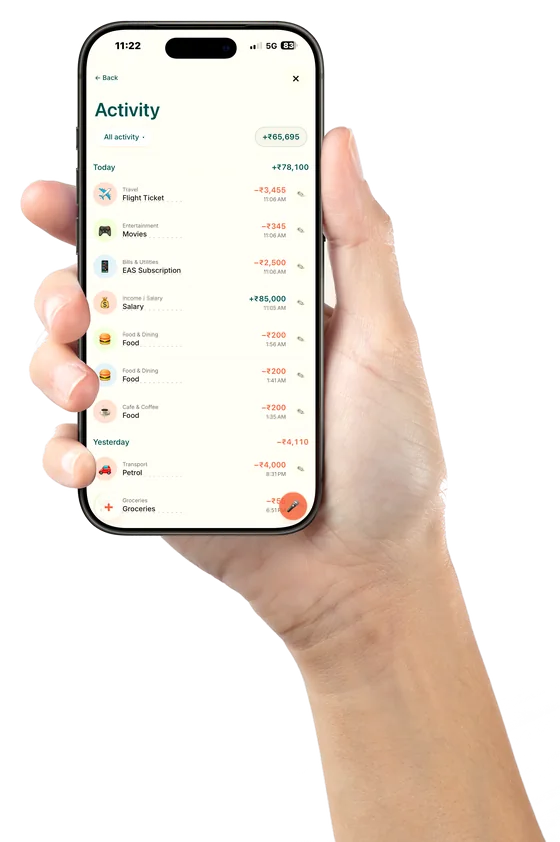
TLDR Money will read the transaction alerts already sitting in your Gmail and file each one automatically, backfilling three months of history when you connect the account, so the first screen has a real pattern on it rather than an empty state — which matters, because one week of data tells you nothing and three months tells you almost everything. That is in development: version one on Android is manual entry, and it is free. What those alerts contain, and where parsing them breaks down, is worth understanding before you trust any tracker with the job.
Every transaction, already sorted
UPI debits, card spends and salary credits parsed and categorised automatically — in development, not in version one.
Works on any phone
The capture layer will be your mailbox, not the handset — so iPhone and Android will behave identically.
No SMS, no bank login
Read-only mail access. Never your texts, never your credentials, never your OTPs.
Read-only is a structural ceiling: moving money, placing trades and opening accounts are not operations that exist in a mail scope. Your mail will never be stored on our servers either — it will be parsed and redacted on your own device, and what we keep will be the parsed record, encrypted, in India. See the security page for the architecture and the privacy policy for your rights over the data.
TLDR Money will earn from one line, your subscription. No ads, no referral fees, no fund distribution commissions, no lending arm. An app that earns by placing a loan in front of you has a reason to read your spending differently. That’s the whole argument on the about page, and the revenue model is on how we make money.
Everything in this cluster
Questions worth asking
How does an automatic expense tracker work in India?
It reads the transaction alerts your bank already sends you and turns each one into a categorised entry. In India almost every UPI debit, card spend and salary credit generates an alert by SMS, email or both, in a fairly predictable format, so a parser can extract the amount, the merchant and the date without you typing anything. The differences between apps come down to which source they read — SMS, email, app notifications, or a direct bank or Account Aggregator connection — and each choice has different privacy and platform consequences.
What can’t an automatic expense tracker see?
Cash. Nothing generates an alert when you hand over a note, so cash spending is invisible to every automatic method without exception. Beyond that, coverage depends on the source: an app reading email can only see accounts that actually email you, and some accounts need alerts switched on in netbanking first. Alerts also aren’t statements — an alert says a transaction happened, but it isn’t a reconciled bank record, so you should still check the figures that matter to you.
Do I have to give an expense tracker my bank login?
No. Reading transaction alerts requires no banking credentials at all, and neither does India’s regulated Account Aggregator framework, which works on revocable consent rather than a shared password. Any app asking for your net-banking username and password to fetch transactions is asking for far more access than reading an alert requires. No legitimate finance company will ask you for a PIN, password or OTP.
Is a free expense tracker app a problem?
Not automatically, but it is worth understanding. A free tracker still has costs, so the revenue arrives from somewhere else — usually brokerage on trades, distribution fees on funds it recommends, interest on a loan it pre-approves, or a referral fee on a credit card. Each of those is legal and normal. Each also gives the product a reason to show you something, and no reason to tell you when the honest answer is to do nothing.
What should I actually look at once I’m tracking?
Three ratios, in this order. First, what share of take-home is already committed to EMIs before you spend anything — RBI’s own figure for non-housing retail loan obligations averages around 26%, and past roughly a third the stacking starts to bite. Second, what is leaking through recurring autopay charges you’ve forgotten. Third, what is genuinely free at month-end, because that is the only number that can become savings or investment.
Does TLDR Money need SMS permission?
No. The planned automatic version will read transaction alerts in your Gmail with read-only access, so it will never request SMS access, never ask for banking credentials, and never see your one-time passwords. Because the capture layer is your mailbox rather than the handset, it also behaves identically on iPhone and Android — unlike SMS-based tracking, which cannot work on iOS at all.
See where your money actually goes
Automatic tracking from your Gmail alerts, with three months backfilled on connect, is in development. Version one is manual.
Join the waitlistWe’ll email you when it’s ready. No spam, ever.
Sources
- Non-housing retail loan obligations and household debt levels — Reserve Bank of India, Financial Stability Report and Trends and Progress of Banking in India — rbi.org.in. The EMI-to-income arithmetic is worked through in full, with per-figure citations, in How much of your salary belongs to the bank.
- UPI Autopay mandates, recurring-payment share and the pre-debit notification requirement — RBI directions and NPCI circulars, cited individually in UPI rule changes in 2026.
- Credit card statement mechanics and interest rates — RBI, Master Direction on Credit Card and Debit Card Issuance and Conduct — rbi.org.in, with the worked example in Where ₹8,000 a month disappears.
- Recurring subscription costs and what they compound into — The ₹500 subscription trap.
Each figure above is sourced in the linked article, where the specific publication and date are cited. This is an explanation of how expense tracking and these ratios work, not advice about your own money.