Guide your money, don't let money guide you.

TLDR Money is an expense tracker and personal finance app for India. You add what you spend and it sorts into categories built for India; automatic Gmail tracking, whole-net-worth valuation and your FIRE date are in development.

There are no ads in it, and it will be funded by subscription alone when the paid plans arrive — no referrals, and no fund you never asked to buy.

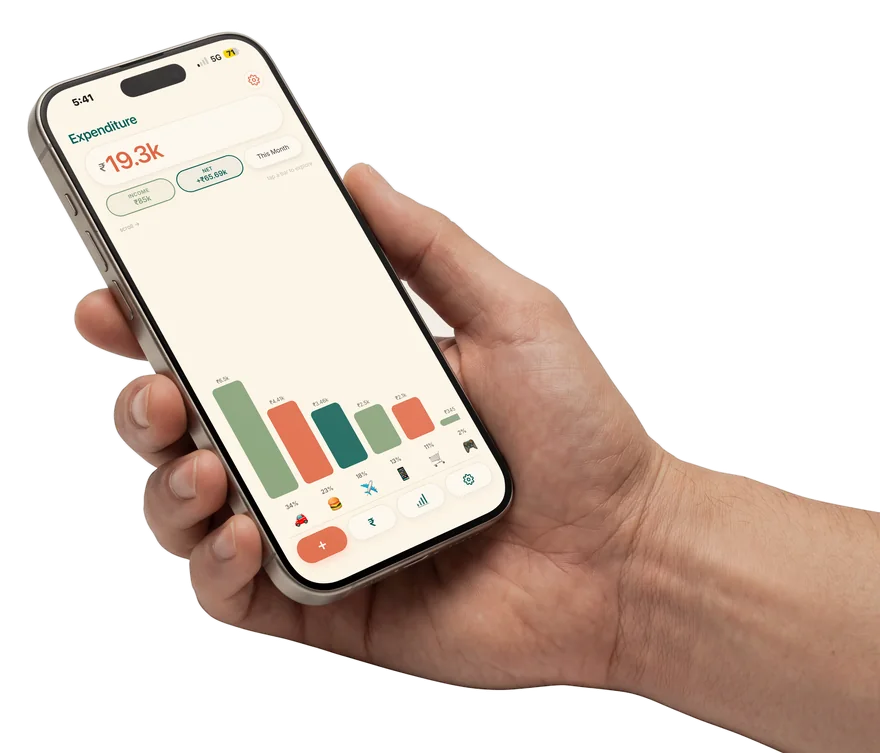
The TLDR Money Expenditure screen on an iPhone held in one hand: ₹19.3k spent this month against ₹85k of income, above a bar chart of spending by category.
Why we're paid, not free

A free finance app still has to make money.
Just not from you.

When the tracking is free, the revenue comes from somewhere else — and that somewhere else is usually a product being sold back to you. We took the other path.

Free apps earn from
  • → Brokerage commissions on trades
  • → Loan and credit-card referrals
  • → Distribution fees on the funds they sell you

All legitimate. But each one gives the app a reason to sell you something.

TLDR Money will earn from
One line.

Your subscription. That's the whole business model.

  • ✓ No lending arm
  • ✓ No insurance to sell
  • ✓ No payout when you buy a mutual fund

The subscription is the alignment. We only do well if the product is worth paying for — not if we can point you toward something else.

What you get

Three numbers that actually run your money.

Once automatic tracking ships, it will work from day one — including the three months before you signed up.

📥

Every transaction, already sorted

TLDR will read your Gmail UPI and salary alerts and file each one automatically, backfilling three months of history when you connect. That is in development, and is not part of the first version. More on how automatic expense tracking works in India.

Food & Dining Groceries Bills
📈

Everything you own, one number

Mutual funds, stocks, gold, real estate and FDs roll up into a single net-worth figure with one honest trend line. More on tracking net worth in India.

Net worth
₹2.4Cr
🎯

Know the date you're free

Your FI number, how far along you are, and a projected retirement date — modelled for Lean, Coast and Fat FIRE. More on calculating your FIRE number in India.

FI progress 63%
Projected free by 2041
The app itself

What it looks like on your phone.

Three screens, exactly as they ship. No dashboard to assemble first, and no template to fill in.

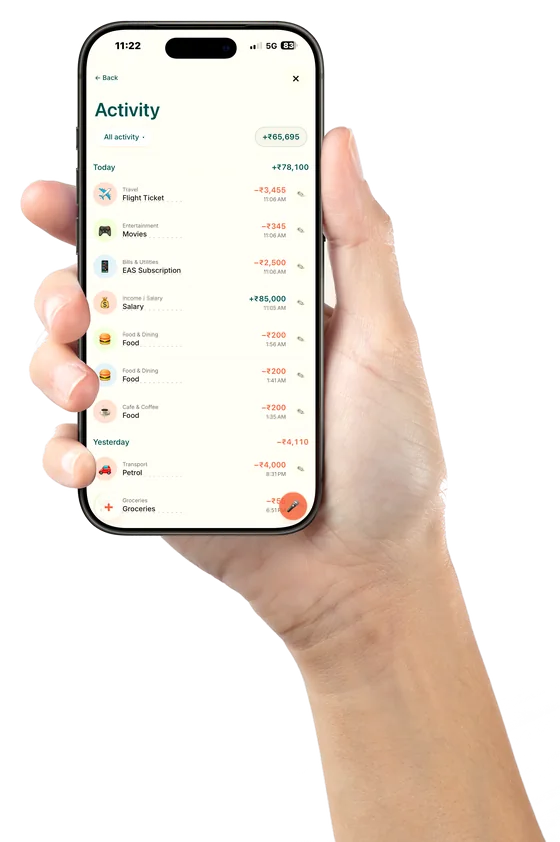
The Activity screen on an iPhone held in one hand, listing each transaction with its category, amount and time, grouped and totalled by day.

Activity

Every rupee, in one list.

One timeline for the month — what came in, what went out, and the category it landed in. Grouped by day and totalled as you scroll, so a heavy week is obvious without you counting anything.

  • Grouped by day, and each day totalled at its own header
  • A running net figure for the whole period above the list
  • Narrowed from the header when you want one kind of row only
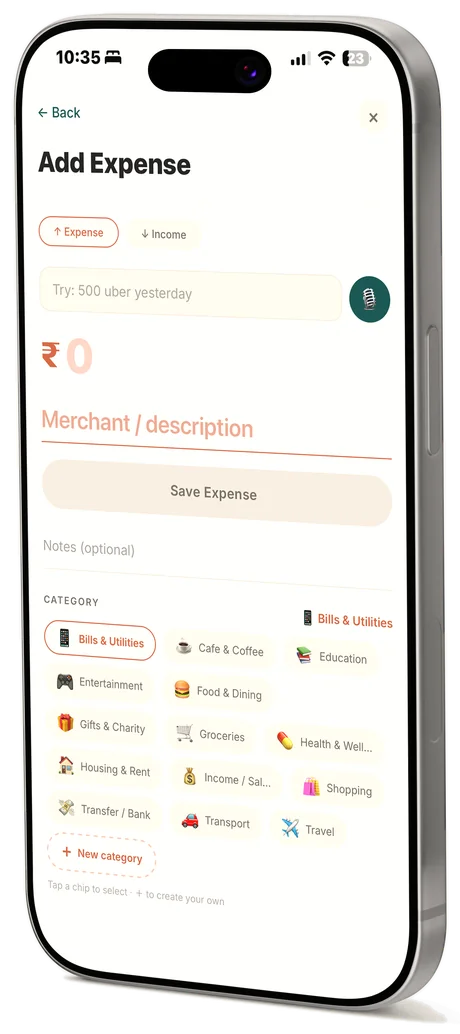
The TLDR Money Add Expense screen: an amount field, a merchant field, a microphone button for voice entry, and a grid of category chips.

Add expense

Cash takes about five seconds.

In version one everything gets typed in: amount, category, done — the chai, the auto and the card spend alike. Mail alerts for cards and UPI, and voice entry that drops the amount, the merchant and the date into the right fields on their own, are both in development.

  • Amount, merchant, category, save
  • In development: dictate it, and those fields fill themselves
  • Income goes in on the same screen, one toggle across
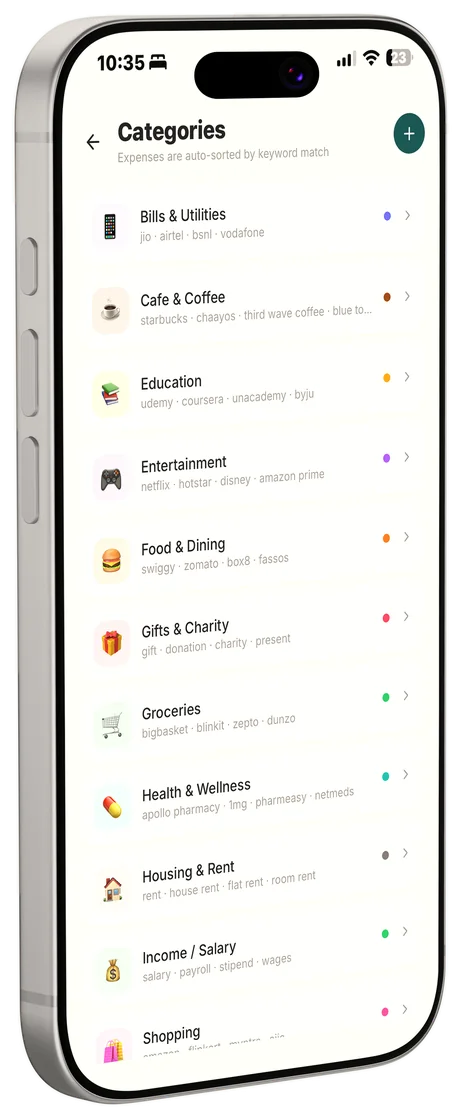
The TLDR Money Categories screen, listing categories such as Food and Dining and Transport, each with the merchant keywords that sort into it.

Categories

Sorting that already knows Indian merchants.

Fourteen categories to start with, each matching on the merchant names you already see on a statement. Rename them, add your own, and everything after that files itself the same way.

  • Fourteen to start with, each with its own colour
  • Every one carries the merchant keywords it matches on
  • Add your own, or edit any of the defaults
Local-first by design

Designed so your mailbox never leaves your phone.

Your mailbox is read, stripped and redacted on your own device. What we store is the result — amount, merchant, date — in India, and deletable by you. The architecture is the privacy policy.

Read on your device, not on our servers

Your mailbox will be parsed on your phone. Headers, signatures and identifying details will be stripped there — only a short redacted snippet will ever be sent on.

Read-only access, nothing more

When mail parsing ships it will categorise spend and detect salary credits from transaction alerts. TLDR can never move money, place trades, or open accounts on your behalf.

Never sold, never shared

No third-party data brokers, no ad networks, no anonymised-and-resold loophole. Export or delete everything whenever you want.

DPDP compliant

Built to India's Digital Personal Data Protection Act, and your transaction data is processed and stored in India. Access, correct and erase it — and withdraw consent any time.

Questions worth asking

How is this different from INDmoney, Kuvera, or Groww?

They're free because they make money elsewhere — brokerage commissions, loan referrals, distribution fees on the funds they sell you. That means their incentive is to sell you something. TLDR Money has one revenue line: your subscription. We don't have a lending arm, we don't sell insurance, we don't get paid when you buy a mutual fund. That leaves one way for us to earn: build something you keep paying for. We've written the comparisons out one by one — against spreadsheets, Mint, Walnut and broker apps.

What data does TLDR Money access?

Version one asks for no account access at all. The planned automatic version would use read-only access to the transaction alerts in your Gmail — UPI debits, card spends, salary credits — plus the asset values you add for net worth. The mail would be parsed and redacted on your own device, so no raw email would reach our servers; what we would store is the parsed record — amount, merchant, date — encrypted, in India. We never move money, place trades, sell it, or share it.

How does cancellation work?

Nothing to cancel today, because nothing is charged yet. Once paid plans arrive you will cancel in one tap from inside the app, keep full access until the end of the period you already paid for, and be able to export all your data on the way out.

Will there be a free trial when paid plans arrive?

That has not been decided, because no paid plan exists yet. What is settled is that nothing is charged today, and you would only ever pay by actively choosing a plan.

Start understanding your money

Funded by subscription when it arrives — no ads, no referrals, no commissions. Nothing is charged today.