How to budget as a couple
To budget as a couple, agree which costs you share, choose how to pay for them (one joint pot, a split, or a hybrid of the two), set a monthly budget for the shared costs, and look at the month together when it ends. Each of you also keeps some money that needs no explaining.
How it works, in five steps
- List what you spend together. Rent or the mortgage, bills, groceries, meals out together, the car, holidays. Use the last two or three months of real spending, not a guess.
- Agree what counts as shared. Draw the line once, including the grey areas: presents for each other’s families, hobbies, clothes.
- Choose how you’ll pay for it. A joint account for everything, a split of the shared costs, or a hybrid. The next section covers each.
- Set a monthly budget for the shared costs. A total, and limits for the categories that tend to run over. Start from what you actually spent, then adjust.
- Look at the month together. Once a month, compare what was spent with the budget, change what didn’t work, and leave it there.
Three ways to share money
Couples who budget together usually settle on one of three set-ups. None of them is right for everybody. They differ in how much is pooled, how much each person keeps, and how much tracking it takes to stay fair.
Joint: everything in one pot
Both incomes go into one joint account, and everything is paid from it, shared or not. There is one budget and one set of numbers. It is the simplest to run, and it suits couples who already think of all their money as the household’s.
The cost is privacy. Every purchase is visible to both of you, so a present is hard to keep a surprise, and a small spend can turn into a conversation. If you go fully joint, agree a personal amount for each of you that neither has to explain.
Split: shared costs divided, the rest separate
Each of you keeps your own account. The shared costs are divided between you, and the rest of each income is that person’s own. The division is usually one of two kinds:
- Equal. Each of you pays half. It is simple, and it feels fair when you earn about the same.
- In proportion to income. Each of you pays the same share of what you earn. If one of you earns 6,000 a month and the other 4,000, shared costs of 3,000 split 60/40: 1,800 and 1,200, which is 30% of each income.
A split needs a way to settle up. You can take turns paying and square up at the end of the month, or each take on set bills, one the rent and the other the groceries and utilities, sized to match the split you agreed.
Hybrid: a joint pot for shared costs
Each of you moves an agreed amount, equal or in proportion to income, into a joint account every month, and the shared costs are paid from it. Whatever each of you keeps is your own. There is nothing to settle at the end of the month, because the transfers are the split.
A hybrid keeps the shared budget in one place and personal spending private. It costs one more account and a monthly transfer, and the amounts need a fresh look whenever either income changes.
Joint, split and hybrid compared
| Detail | Joint | Split | Hybrid |
|---|---|---|---|
| Where income goes | One joint account | Each person’s own account | Each person’s own, with a monthly transfer into a joint pot |
| Who pays shared costs | The joint account | Each of you, by the split you agreed | The joint pot |
| Settling up | Not needed | Needed, monthly or bill by bill | Not needed |
| Personal spending | Visible to both of you | Private | Private |
| Suits couples who | Treat all their money as the household’s | Earn about the same, or want to keep things separate | Want a shared budget and money of their own |
| Watch for | Small spends becoming conversations | Keeping track of who owes what | Transfers that no longer match your incomes |
Splitting shared costs fairly
Fair is whatever the two of you agree is fair, and the two common rules are equal and proportional. Equal is easy to explain. Proportional means the lower earner isn’t left with much less of their own once the shared costs are paid. With the same numbers as above, an equal split of 3,000 leaves the higher earner 4,500 of their own and the lower earner 2,500; a proportional split leaves 4,200 and 2,800.
Whichever you choose, write it down, include the costs that don’t come every month, like insurance, a car service or presents for family, and look again whenever either income changes.
A monthly money check-in
Set a regular time, once a month, to look at the shared spending together. Keep it short and practical. Four questions cover most of it:
- What did we spend, by category, against the budget?
- Did anything surprise either of us?
- What is coming up next month: a trip, a birthday, a bill paid once a year?
- Does the split, or the transfer, still fit what we each earn?
Look at the numbers, not at each other’s choices. If a category runs over every month, the budget may be the thing to change.
Keep some money that is just yours
Whichever set-up you choose, give each of you an amount to spend without asking or explaining. It takes small purchases out of the shared conversation, and it lets a present stay a surprise. Agree the amount once, equal or in proportion to income, and treat what each of you does with it as private.
This is also why a shared budget doesn’t need to cover everything. It needs to cover what you actually share.
Doing each method in TLDR Classic
TLDR Classic keeps one ledger for the two of you, called Ours, and a private one each, called Mine. You both write in Ours from your own phones, and every entry shows who added it. Each set-up maps onto it like this:
- Joint. Put all your spending in Ours and give it a monthly budget and category limits. Ours tracks spending only, so each person’s income stays in their own Mine.
- Split. Put the shared costs in Ours and your own spending in Mine. Activity in Ours filters by person, and Ask can tell you how much each of you added this month, which gives you the figures to settle up. TLDR Classic doesn’t work out the split or keep a balance; that part stays with the two of you.
- Hybrid. Put what the joint pot pays for in Ours, with a budget that matches the monthly transfers, and keep everything else in Mine. Set Ours’ month to start on the day the transfers go in.
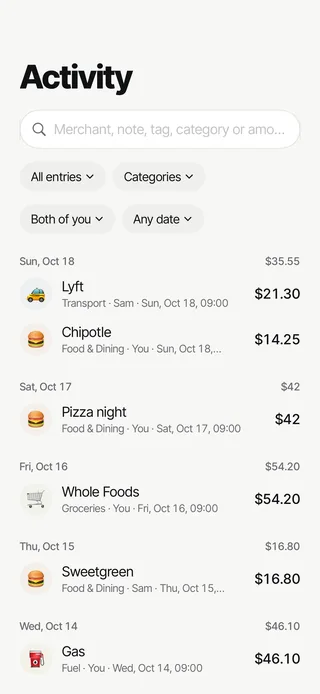
Ours has its own budgets, categories, repeating entries and lists, so rent and bills can add themselves on their day. It never connects to a bank: each of you writes a spend as a short line, like “groceries 62”, or says it. Ours is part of Pro, and only one of you needs it. Pro is US$3.99 a month or US$24.99 a year (₹399 or ₹2,999 in India), and your store shows your price before you buy. Every new account gets Pro free for 30 days, no card needed.
More on the app: a budget app for couples, a shared expense tracker, and a budget app that doesn’t connect to your bank.
Keep reading
Questions worth asking
How do couples budget together without a joint account?
Agree which costs you share and how to divide them, equally or in proportion to income, then each pay your part from your own account and keep the shared spending in one record you can both see. A shared ledger in an app, like Ours in TLDR Classic, does the last part without a joint account.
Is it better to split expenses 50/50 or by income?
An equal split works when you earn about the same; a split in proportion to income leaves each of you a similar share of your own money when you don’t. With incomes of 6,000 and 4,000, shared costs of 3,000 split 1,800 and 1,200, which is 30% of each income.
What is a hybrid budget for couples?
A hybrid budget is one where each partner moves an agreed amount into a joint account every month for shared costs, and keeps the rest in their own account. It combines a shared budget with money each of you doesn’t have to explain.
How often should couples talk about money?
Once a month, at a set time, is a practical rhythm. It lines up with pay and bills, and it is often enough to notice a category that keeps running over before it becomes a habit.
What expenses should couples share?
Usually the household’s: rent or the mortgage, bills, groceries, and what you do together, like meals out and holidays. Clothes, hobbies and presents for your own family are the grey areas, so agree on them once instead of case by case.
Run your budget for two in one place
Every new account starts with 30 days of Pro, no card needed, so you can set up a shared ledger on the first day. On Android now. The iPhone app is in Apple’s review.

iPhone: coming soon
This is general information about organising money as a couple, not financial advice. The section on TLDR Classic describes how the app works as of November 2026.